Paphos • Dec 11

How to Train Your Robot

A Practical Guide to Physical AI

From Hard-Coded Logic to Learned Skills

Sergey Arkhangelskiy
Positronic Robotics
Conceptual visualization of AI and Robotics

My Journey to Robotics

Following the "Data Complexity" Curve

Google (Search Ranking)

Organizing the world's text.

Google

WANNA (Acq. by Farfetch)

Computer Vision & AR.

Wanna

Farfetch

Fashion Tech Platform.

Farfetch

Positronic Robotics

Physical AI.

Positronic
Sergey Arkhangelskiy

Sergey Arkhangelskiy

Founder & CEO @ Positronic

We Have Seen This Movie Before

The shift from "Engineering" to "Learning"

Search & NLP

Grammar rules
Transformers

Computer Vision

Edge detection
CNNs & ViTs

Robotics (Now)

Scripts / Rules
End-to-End Policies
Unbranded robotic gripper failing to grasp cup on conveyor due to alignment error

The Trap of Explicit Programming

The world is too messy for 'If/Else'

The "Long Tail" Problem

  • ⚠️ Lighting changes by 10%
  • ⚠️ Object moves by 5mm
  • ⚠️ Cable stiffness varies
Moravec’s Paradox:
"High-level reasoning is easy. Low-level motor skills are hard."

End-to-End Learning

Pixels $\to$ Actions

Explicit Code

Manually programmed logic.

if sensor > 5:
move_x(10)
Brittle

Learned Policy

Shown what to do.

$$a_t = \pi(o_t)$$
Generalizable

What Does the Model See?

Multimodal Fusion

Inputs ($o_t$)

  • Vision: RGB Images
    (Wrist + 3rd person)
  • Proprioception: Joint angles, Gripper 3D position, Gripper width
  • Language: "Put the red block on the plate"

Outputs ($a_t$): Action Chunking

Predicting the Future.

$\pi(o_t) \to \{a_t, ..., a_{t+k}\}$

Ensures smoothness & temporal consistency.

View Data Visualization Server ➔

Robot Training Data: Inputs (Vision/State) and Outputs (Trajectory)

The "Robot Internet" Doesn't Exist (Yet)

We have to build the dataset manually

Teleoperation (The Gold Standard)

Humans "puppet" the robot to collect ground-truth data.

Quality is king: "Garbage In, Garbage Out."

  • Device: Leader Arms (ALOHA) or VR (Meta Quest 3).
  • Costly but necessary for manipulation.

Sim-to-Real (RL)

Training in physics engines (Isaac Lab, MuJoCo).

Great for locomotion, hard for contact-rich manipulation.

Quality > Quantity

Insights from Generalist Models

Active Data

Volume: Tiny

"The Body"

Passive Video

Volume: $\infty$

"The Brain"

"We have infinite eyes, but very few hands."
Current Reality: Quality > Quantity

ACT: Action Chunking with Transformers

Tony Z. Zhao et al. (2023)

Uses a CVAE (Conditional Variational Autoencoder) to model multimodal action distributions, handling the inherent uncertainty in human demonstrations.

Key Idea: Action Chunking

Instead of predicting one step at a time, predict a fixed sequence (chunk) of actions ($k \approx 100$). This drastically reduces "compounding errors" (drifting off course) and produces smooth, coherent motions.

ACT Architecture Diagram

Project GR00T

NVIDIA (2024/2025)

Designed specifically for humanoid robots to be general-purpose assistants.

Key Idea: Dual-System Architecture

Inspired by "System 1 vs System 2" thinking.
System 2 (Slow): A VLM planner reasons about the task and goals.
System 1 (Fast): A high-frequency policy executes the motor skills.

Project GR00T Diagram

$\pi_{0.5}$

Physical Intelligence (2024/2025)

A true VLA (Vision-Language-Action) foundation model. Pre-trained on 10,000+ hours of diverse robot data (OXE + Proprietary).

Key Idea: Flow Matching

Uses Flow Matching (a simpler, faster alternative to Diffusion) to generate continuous action trajectories. This allows a single "brain" to control many different robot bodies by learning a shared physical understanding.

Pi0.5 Flow Matching Diagram

The "Zero-Shot" Myth: The Generalization Gap

Why "Generalist" models still struggle in the real world

1. The Reality Check

The Test: We ran a Droid-tuned model on a Droid robot.

The Result: Failure. Even with identical hardware, the policy broke.

2. The Root Causes

Data Starvation: We lack the data scale to learn generalized physics (friction, mass).

The RL Gap: Robots cannot safely "practice and fail" in the wild to self-improve.

3. The Verdict

Fine-Tuning is Mandatory.

Foundation models give you the "syntax" of movement; local data gives you the "semantics" of the task.

State of the Art

What is actually possible?

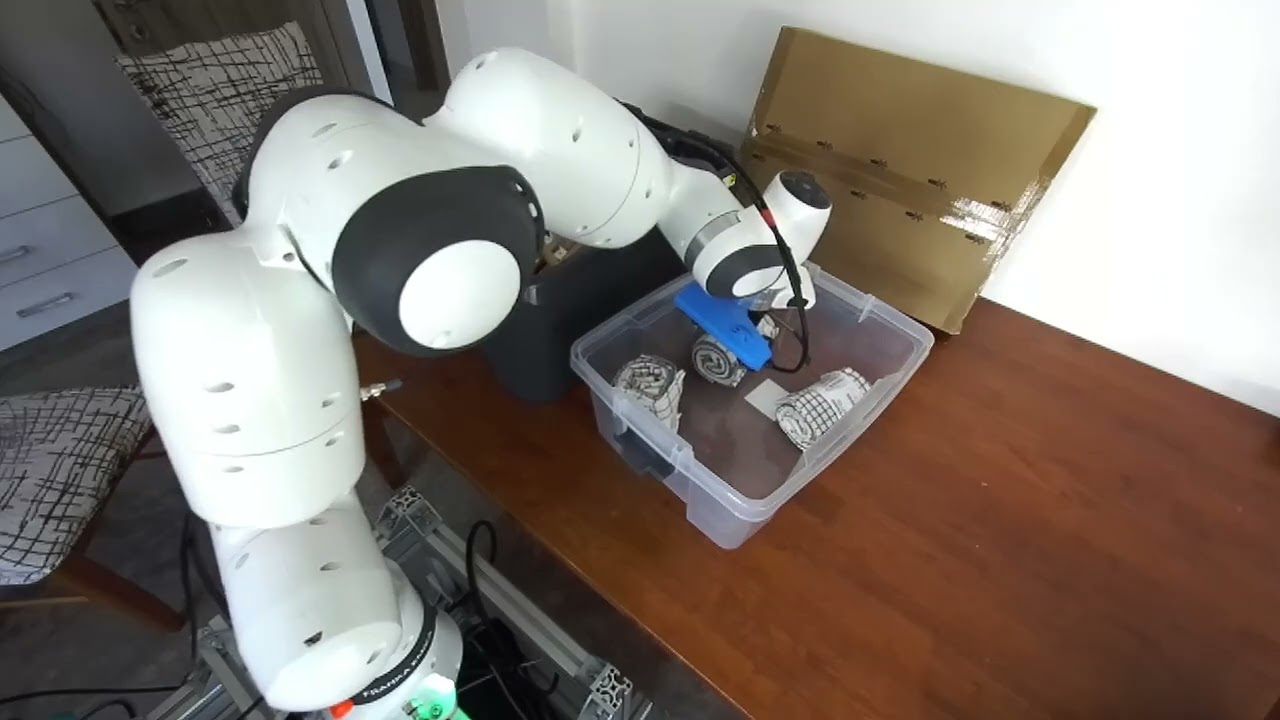
Positronic's fine-tune for Pick-and-Place task
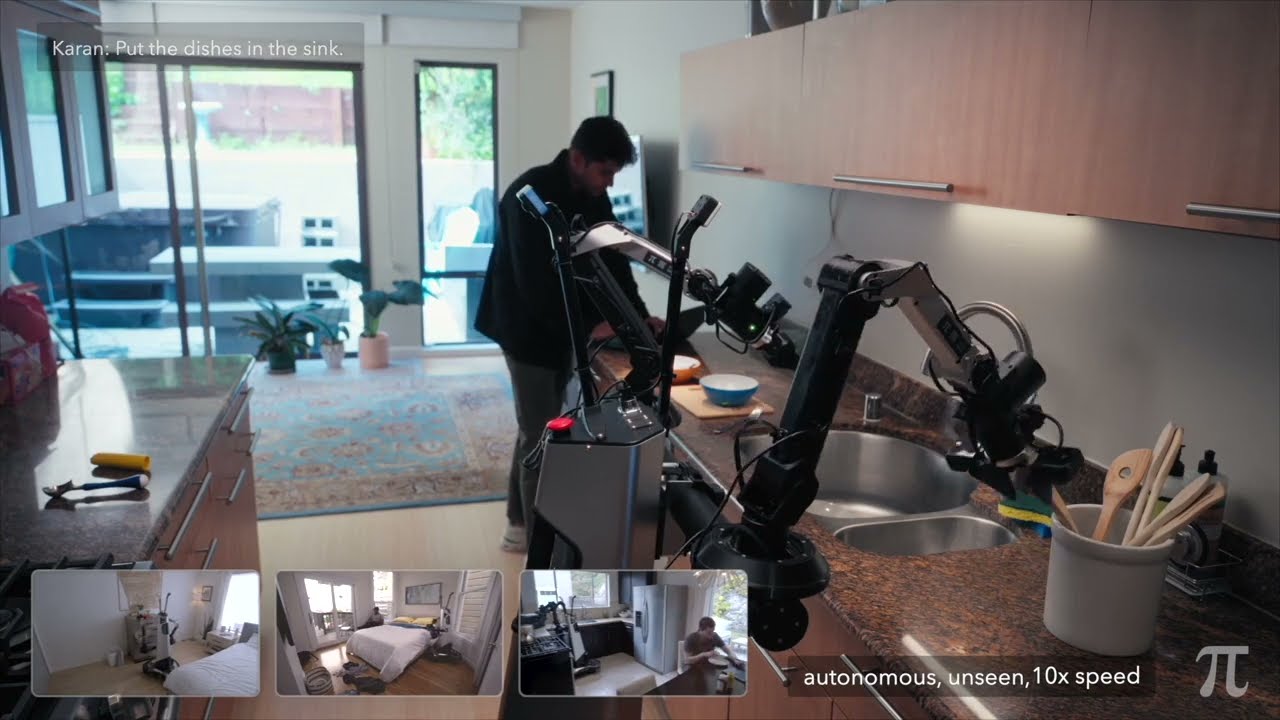
Physical Intelligence SOTA
Physical Intelligence (SOTA)

Positronic: The Toolset to "Train Your Robot"

A Python-Native Stack for the Full Lifecycle

1. The "Glue"

We bridge the gap between raw hardware drivers and high-level training libraries.

A unified OS: Collect $\to$ Manage $\to$ Train

2. The Workflow

  • Collection: Accessible teleop via mobile / VR.
  • Orchestration: pimm & dataset.
  • Training: Native OpenPI, LeRobot integration.

3. The Vision

We handle the infrastructure plumbing so you don't have to.

You focus on the data and the policy.

Collection

iPhone / WebXR

pimm / S3
$\xrightarrow{manage}$

Training

LeRobot / OpenPI

Inference
$\to$

Real World

Robot Execution

The Future is Physical. Build It With Us.

The "Web 1995" Moment for Robotics

1. The Barrier is Gone

  • Hardware: Build an arm for <$200, or dual-arm for <$5,000.
  • Software: Positronic is Open Source & Python-native.
  • Data: Collect it with the phone in your pocket.

2. Your Next Steps

  • Star the Repo: Explore code, try WebXR teleop.
  • Join the Hub: Building the community here in Paphos.
  • Start Collecting: We need your data & experiments.
Scan to join Positronic Robotics

Scan to Join Discord & GitHub

Sergey Arkhangelskiy

Positronic Robotics