
mimic's FLUX-mimic-x and Runway's Praxis-1 tested on real robots: top reliability, top speed, quick recovery
PhAIL tests physical AI models in simulation and on a real Franka arm. On the DROID tasks, which run on the real arm, we added two models: mimic FLUX-mimic-x and Runway Praxis-1. Each episode has a limit of 240 seconds.
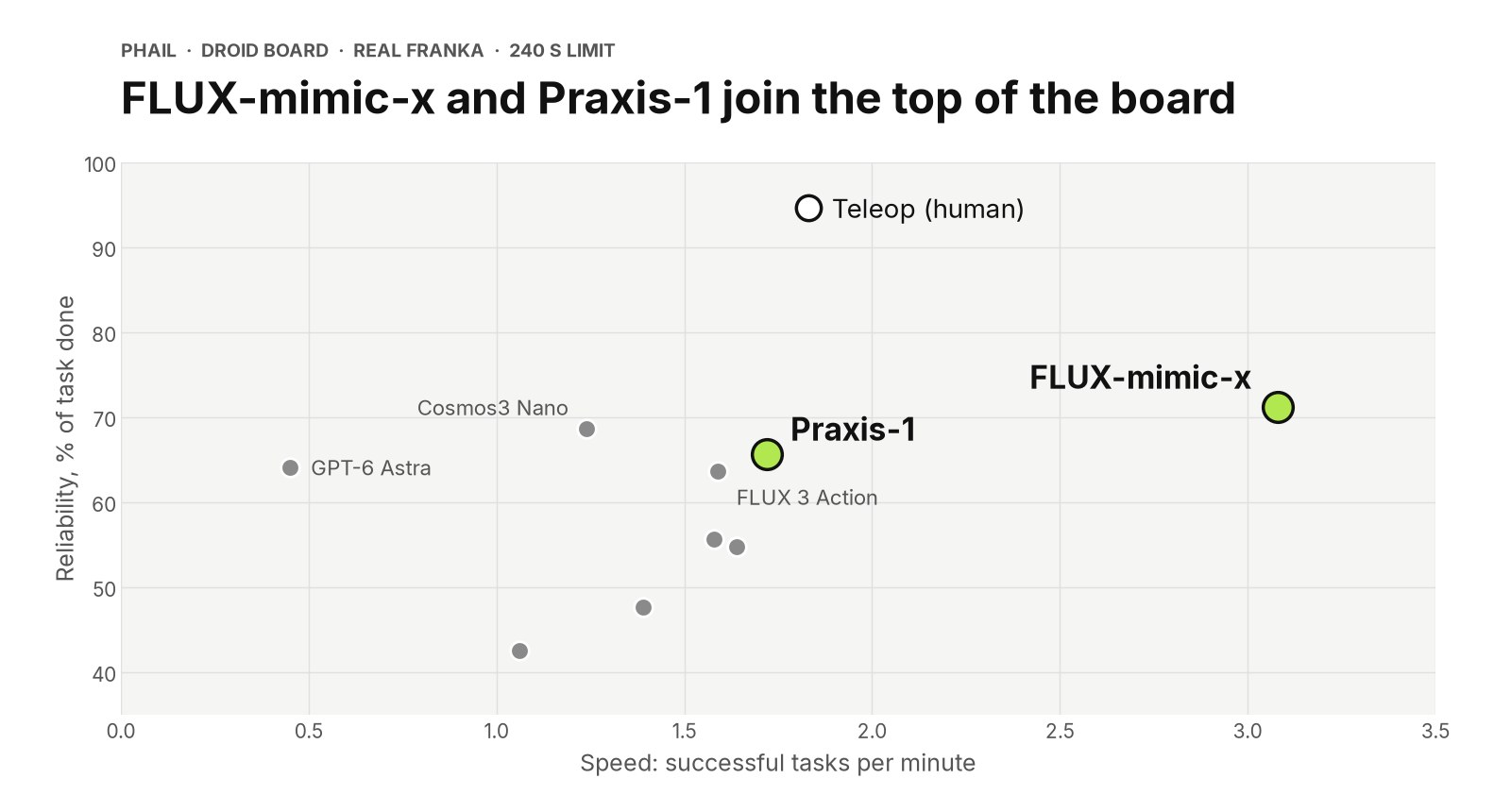
| Model | Reliability | Speed |
|---|---|---|
 Teleop (human) |
94.7 | 1.83 |
 mimic FLUX-mimic-x |
71.2 | 3.08 |
 NVIDIA Cosmos3 Nano |
68.7 | 1.24 |
 Runway Praxis-1 |
65.7 | 1.72 |
 OpenAI GPT-6 Astra |
64.1 | 0.45 |
 Black Forest Labs FLUX 3 Action |
63.7 | 1.59 |
Reliability is the percent of the task done within the time limit. Speed is successful tasks per minute. FLUX-mimic-x has the highest Reliability of any model so far, after its first 100 runs, just ahead of three other models, among them Runway's new open model, Praxis-1.
FLUX-mimic-x is faster than our human operator
FLUX-mimic-x has the highest Speed on the board. It is above the human who drives the same arm with a teleoperation rig. On the tasks that both ran, a success took FLUX-mimic-x a median of 11 seconds, and the human 27 seconds. The human still succeeds more often.
The arm also almost never waits for the model. The next actions are ready before the current ones run out, so the arm keeps moving.
What it is
mimic published FLUX-mimic-x as a preview on 16 November. It is a video-action model, made with mimic's mimic-video recipe on top of Black Forest Labs' FLUX 3 video model. mimic trained it on no simulation data, and on no data of this robot beyond the public DROID dataset.
A video model learns how objects move before it sees a single robot action. We think this pretraining is the main reason for its speed and its reliability.
Praxis-1: a missed grasp is not a lost task
When Praxis-1 loses its hold on an object, it tries again and often finishes the task. Of the episodes where the object slipped from the gripper, 66% still ended in a success, and 79% of these successes took less than 60 seconds.
Praxis-1 also moves at the pace of our human operator: on the same tasks, its median time to a success is the same as the human's.
Praxis-1 also has results on the two simulated Franka boards of PhAIL, RoboLab and MolmoSpaces. FLUX-mimic-x has results there too. On RoboLab, its Reliability is 51.7 and its Speed 1.86, close to FLUX 3 Action and Praxis-1. On MolmoSpaces, its Reliability is 48.1 and its Speed 4.85, the highest values on that board. Runway released Praxis-1 on 11 November as open weights, under Apache 2.0, so anyone can run it and train it further. It is a diffusion transformer that predicts video and actions together.
The leading robot models all predict video
Two kinds of robot model compete today. One kind builds on a vision-language model, which learns from images and text. The other kind builds on a video model, which learns from video how objects move. A model of the second kind predicts the next video frames together with the next actions.
On the DROID board, the five highest Reliability scores are, in order, FLUX-mimic-x, Cosmos3 Nano, Praxis-1, GPT-6 Astra and FLUX 3 Action. Four of them are robot models, and all four are of the second kind. FLUX-mimic-x and FLUX 3 Action build on FLUX 3. Cosmos3 Nano builds on NVIDIA's Cosmos 3 world model. Praxis-1 builds on Runway's video models. GPT-6 Astra is a general AI model, not a robot model: it controls the arm by itself.
The robot models of the first kind are lower on the board. π0.5 builds on PaliGemma, GR00T N1.7 on Cosmos-Reason2, MolmoAct2 on Molmo2-ER, and G0.5 on Qwen3.5. Each of these is a vision-language model.
NVIDIA made the same change in its own robot models. GR00T N1.7 builds on a vision-language model. GR00T 2, which NVIDIA introduced in November, is a world-action model: it predicts future video and robot actions together. We hope to see it on the leaderboard soon.
All episodes of both new models are on the DROID board, with video from three cameras.